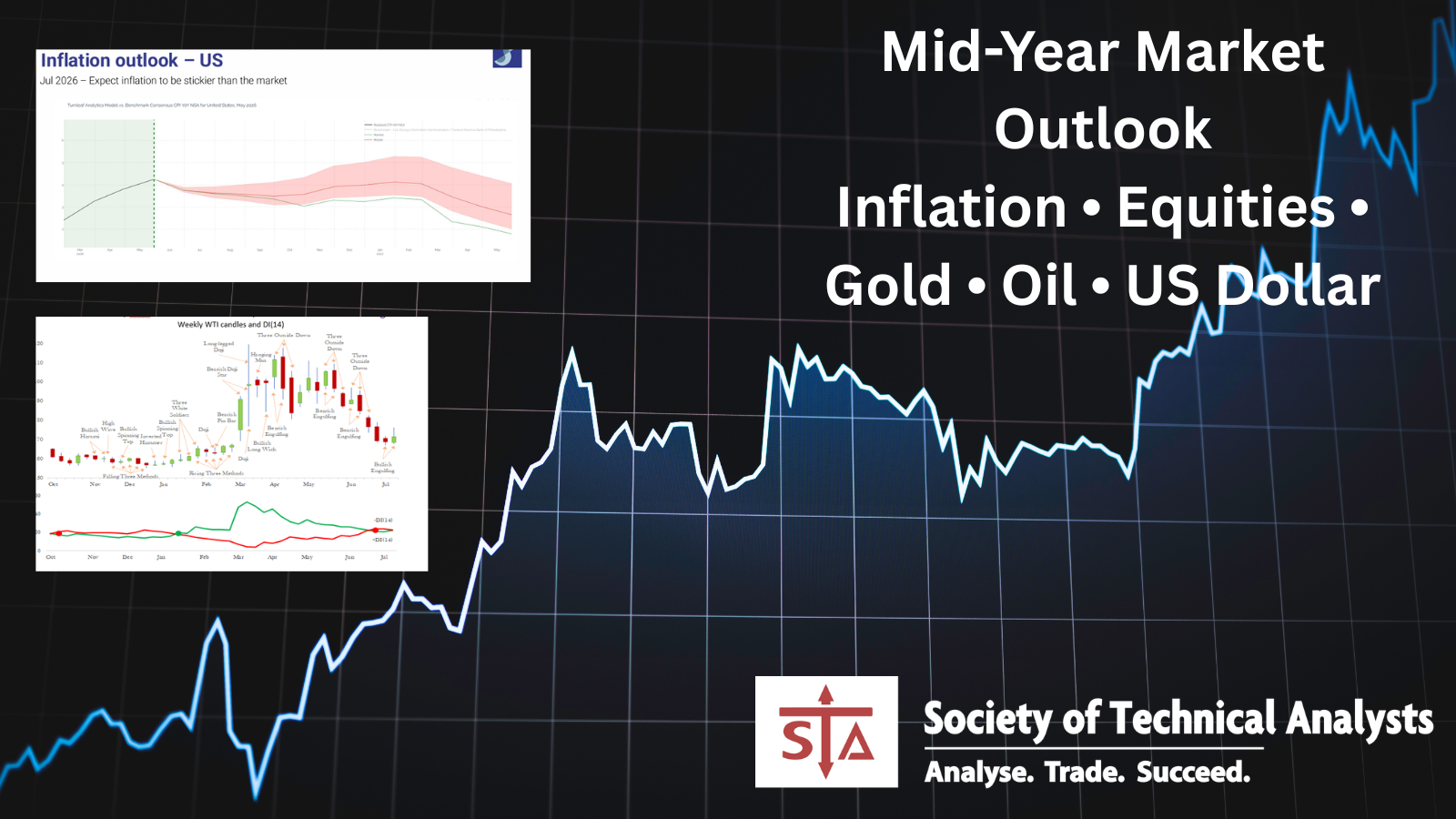
Mid-Year Market Outlook: What Technical Analysts Should Be Watching
One of the things I enjoy most about the Society of Technical Analysts' Mid-Year Market Outlook is hearing different approaches applied to the same markets. Some analyse the macroeconomic picture, others focus on fundamentals, while my own approach is firmly rooted in technical analysis.
Although the methods differ, many of the conclusions this year were remarkably consistent.
Inflation Remains the Biggest Risk
The dominant theme of the evening was that inflation is unlikely to disappear as quickly as markets hope.
Despite some encouraging data, ongoing energy costs, geopolitical tensions and persistent price pressures suggest inflation could remain above central bank targets for longer. If that proves correct, expectations for interest-rate cuts may need to be scaled back.
Why Technical Analysis Matters
One discussion particularly resonated with me.
In markets driven by headlines and political events, fundamental analysis can quickly become outdated. Price action, however, reflects all available information.
Throughout the evening there were numerous examples of technical indicators identifying changes in market sentiment before the wider narrative caught up. It's a timely reminder that technical analysis isn't about predicting the news—it's about measuring how markets respond to it.
Commodities Are Worth Watching
Oil was highlighted as a market showing early signs of stabilisation after a prolonged decline. Improving momentum and bullish technical signals suggest the possibility of a developing base, although confirmation is still needed.
Gold, meanwhile, has entered a healthy correction after a powerful bull run. Long-term support levels, including key moving averages and Fibonacci retracements, are now being tested. Whether these hold could determine the next major move.
Equities Are Losing Momentum
While major equity indices remain close to record highs, momentum is beginning to weaken.
Several markets are showing slower upside progress and momentum divergences. That doesn't automatically signal a bear market, but it does suggest investors should pay close attention to key support levels rather than assume the rally will continue uninterrupted.
Interest Rates and the Dollar
If inflation proves more persistent than expected, higher bond yields and higher-for-longer interest rates could continue to support the US dollar.
Technically, however, the Dollar Index is approaching an important decision point. How it behaves around current resistance levels could shape currency markets during the second half of the year.
The Value of Combining Different Perspectives
One message stood out above all others.
Successful market analysis rarely relies on a single discipline. Macro analysis explains the economic backdrop, fundamentals assess value, while technical analysis reveals what investors are actually doing.
After more than 35 years as a professional technical analyst, I remain convinced that the charts don't replace fundamentals—they complement them.
Markets will always surprise us. Inflation forecasts change, geopolitics shifts overnight and central banks alter course. The one constant is price. Staying objective, respecting the trend and allowing the evidence—not opinions—to guide decisions remains the best way to navigate uncertain markets.
By
Karen Jones FSTA Professional Technical Analyst and Content Creator for the STA
Karen Jones LinkedIn profile linkedin.com/in/karen-jones-fsta-a2907b9
#TechnicalAnalysis #MarketStructure #BehaviouralFinance