From Charts to Strategies: Inside the New STA Course
Last night’s STA presentation felt a bit like watching a long planned idea finally come to life. Jeff opened the session with his usual warmth, introducing Tom Hicks—someone most STA members know well, whether from his years as Chairman, his work with IFTA, or his lectures on systematic trading and trading psychology. Tom has been part of the STA’s DNA for two decades.
Tom began by explaining why this course, From Charts to Strategies, exists at all. And the reason is simple: traders learn the tools, but they often don’t learn how to turn those tools into something they can actually trade.
Tom described the familiar journey many traders go through. You learn indicators, patterns, risk management, and all the classic techniques in Part 1 and Part 2 of the STA diploma. But then comes the real challenge—how do you combine all of that into a structured, repeatable process? How do you know whether a strategy has an edge? And how do you keep your psychology intact when the market inevitably tests you?
He illustrated this beautifully with the story of Isaac Newton’s disastrous South Sea Bubble trade. Newton made money early, got sucked back in by FOMO, and ended up losing far more than he gained. Three hundred years later, nothing has changed. Bitcoin, silver, meme stocks—the human brain still reacts the same way.
That’s the gap this course is designed to fill.
Tom walked through the three pillars of the programme: psychology, structured planning, and system development. What makes this course different is that it doesn’t just teach concepts—it forces you to apply them. Each lecture comes with coursework, not in a school ish way, but in a way that helps you build your own trading framework piece by piece. By the time you reach the final session, you’re not just listening—you’re bringing your own strategy to a panel of three experts for live feedback.
Tom also introduced the other two instructors. Malcolm Prior brings deep experience in spread betting and the Van Tharp methodology, while Stephen Hoad contributes his expertise in algorithmic trading and systematic design. Together, the three of them cover the full spectrum from discretionary to fully systematic trading.
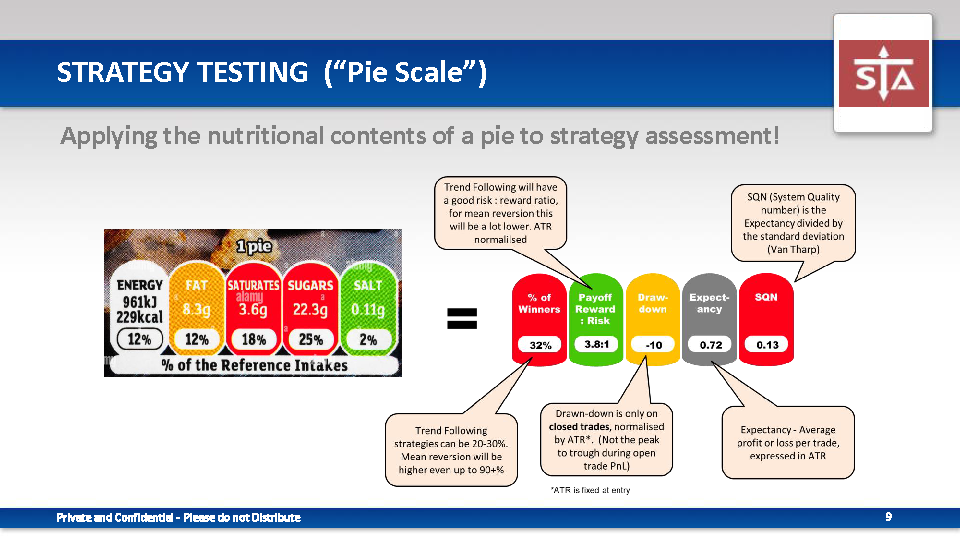
One of the most interesting parts of the presentation was Tom’s discussion of strategy testing. He showed how they’ve taken well known systems, applied them across multiple markets—equities, gold, crypto, FX—and tested them out of sample. He even introduced a clever “pie scale” inspired by a Sainsbury’s pie label, breaking down a strategy’s nutritional content: win rate, payoff ratio, drawdown, expectancy, and system quality. It’s a surprisingly intuitive way to understand whether a strategy is psychologically tradable, not just mathematically sound.
Tom emphasised that the course isn’t only for systematic traders. Discretionary traders often struggle with structure even more, and the course dedicates an entire lecture to building routines, analysing your own behaviour, and treating trading like a business rather than a series of impulses.
By the end of the session, it was clear that this course is something Tom wishes he’d had when he finished the STA diploma. Instead of years of trial and error, traders will now have a guided path from “I know the tools” to “I know how to build a strategy that fits me.”
The course begins in early April, with the early bird discount running until the 25th of March. Judging by the engagement in the Q&A—and the number of people quietly admitting they might be “indicator collectors” or “strategy hoppers”—there’s a real appetite for something that finally connects the dots.
If the presentation was anything to go by, this course is going to be a turning point for a lot of traders who are ready to move from theory to practice, and from charts to strategies.
#FinancialMarkets #QuantTrading #AlgoTrading #RiskManagement #TradingFramework #InvestmentEducation #MarketStructure #TradingCommunity #ProfessionalDevelopment #TraderTraining