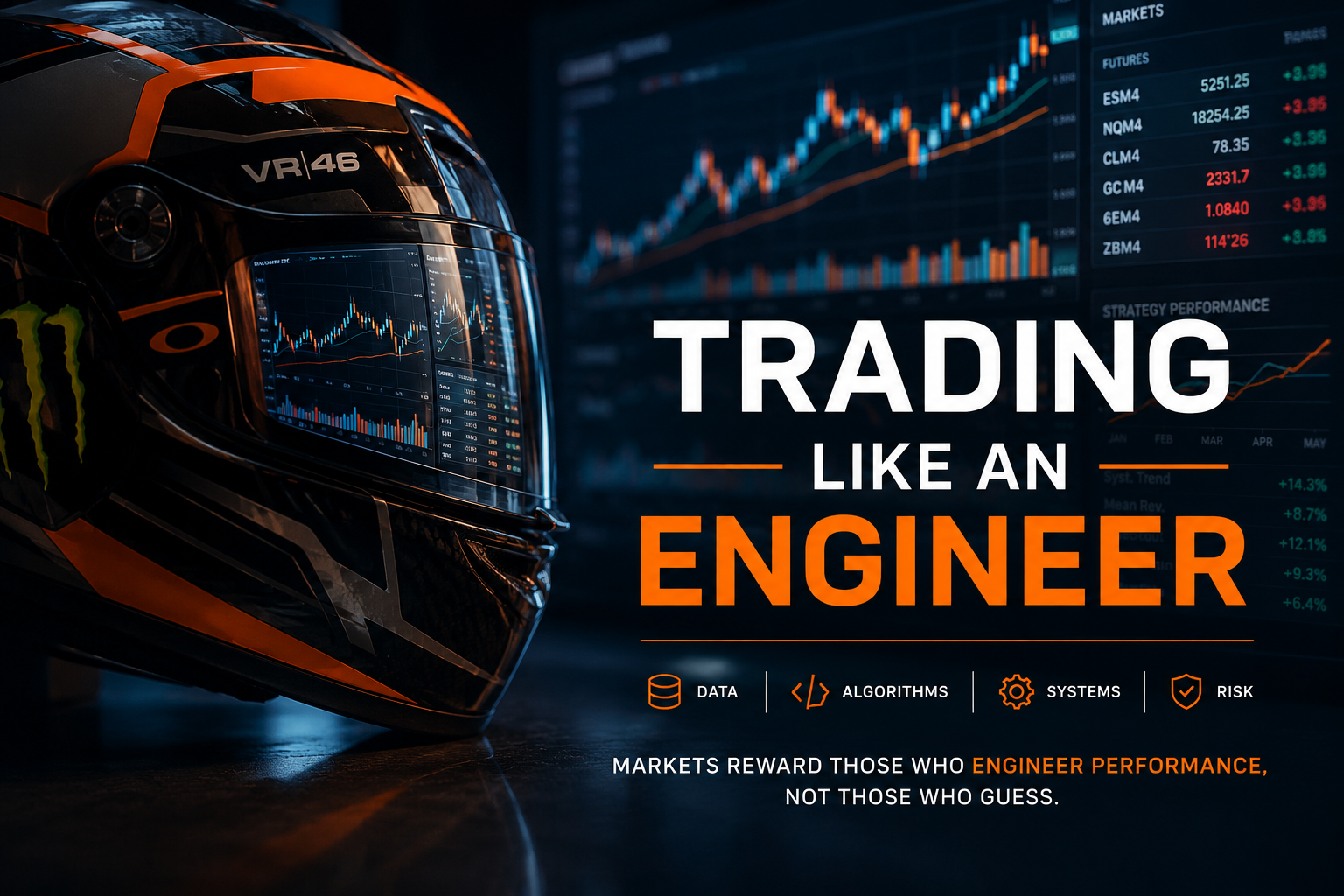
Engineering Trading Systems: What Traders Can Learn from MotoGP
At a recent STA presentation, Dr Enrico Malverti shared an interesting perspective: successful trading has far more in common with MotoGP racing than most people realise.
While one involves financial markets and the other high-performance motorcycles, both rely on the same foundations – data, testing, discipline and risk management. His message was clear:
Markets reward those who engineer performance, not those who guess.
Why Intuition Is No Longer Enough
Today's markets operate 24 hours a day, generate vast amounts of data and are increasingly influenced by algorithms and artificial intelligence. In this environment, relying solely on instinct is becoming more difficult.
Many traders have experienced the same lesson: a setup that appears to work perfectly suddenly fails. According to Malverti, this is often the moment traders realise they need a genuine strategy rather than educated guesswork.
The Engineering Approach
Malverti advocates a structured process for building trading systems:
- Start with quality data – poor data leads to poor decisions.
- Define precise rules – every entry, exit and risk parameter must be measurable.
- Backtest thoroughly – not to predict the future, but to understand how a strategy behaves.
- Manage risk– position sizing and drawdown control are as important as the entry signal.
- Execute with discipline – successful systems follow rules consistently.
As in motorsport, preparation matters more than improvisation.
Keep It Simple
One of the strongest themes of the presentation was simplicity.
Many traders assume more indicators and more complexity lead to better results. In reality, the opposite is often true. Robust systems tend to have clear logic, fewer parameters and work across different markets and timeframes.
The goal is not to build the most complicated strategy, but the most reliable one.
AI Is a Tool, Not a Replacement
Malverti is a strong advocate of using artificial intelligence, particularly for coding, analysing data and identifying patterns. However, he stressed that AI is not a money machine.
Algorithms can help traders process information faster, but they still require human judgement, risk control and critical thinking.
As he put it:
"Algorithms enhance human intelligence – they don't replace it."
Final Thoughts
The key takeaway from the evening was that trading should be approached as an engineering challenge rather than a forecasting exercise.
Successful traders build systems, test them rigorously, manage risk and remain disciplined.
Whether you trade manually or systematically, the principle remains the same:
Victory belongs not to those who guess, but to those who engineer performance.
By
Karen Jones FSTA Professional Technical Analyst and Content Creator for the STA
Karen Jones LinkedIn profile linkedin.com/in/karen-jones-fsta-a2907b9
#TechnicalAnalysis #RiskManagement #Trading #Investing #FinancialMarkets #TradingEducation #BehaviouralFinance #MarketAnalysis #STA #TechnicalAnalysts #Finance #InvestmentEducation