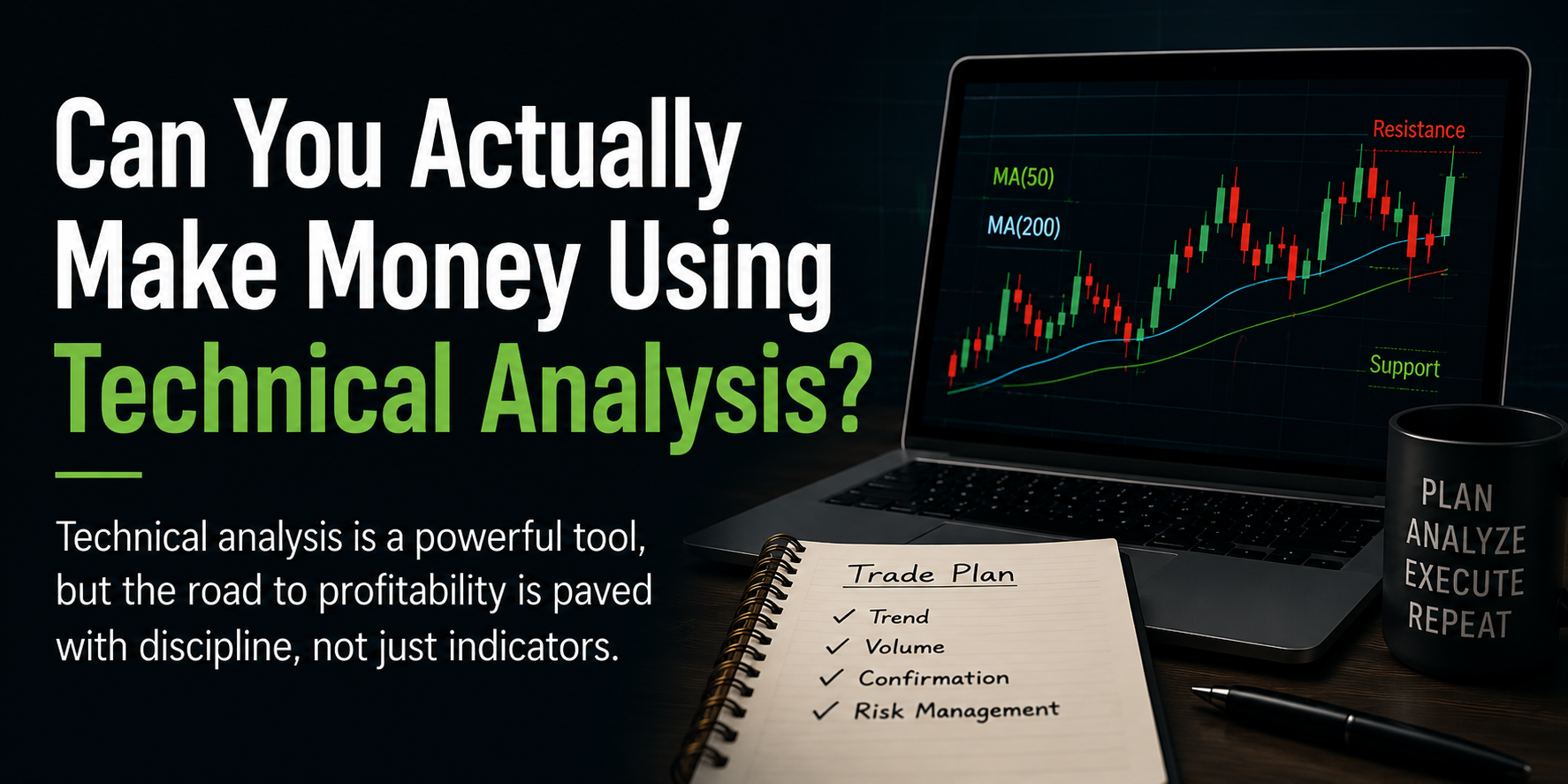
Can You Actually Make Money Using Technical Analysis?
People do make money with technical analysis, I know a number of successful technicians who trade their own money, and I know funds that use it however the success rate for retail day traders is notoriously low. To understand why, you have to look past the colourful indicators and into the cold, hard data.
The Reality Check: Success by the Numbers
Before you spend cold hard cash on a trading course or quit your job, consider the statistics. Recent 2025-2026 data continues to echo what professionals have known for decades and that is only about 1% to 3% of day traders achieve consistent, long-term profitability that exceeds a standard salary. There is also High Attrition - roughly 40% of new traders quit within the first month. By year three, only 13% are still active. Lastly, in 2025, reports showed that over 70% of retail traders ended the year with a net loss.
Does this mean TA doesn't work? No. It means TA is a professional tool being used by people who often lack professional discipline.
Why TA Works (When it Does)
Technical analysis isn't about predicting the future; it's about risk. It works by identifying moments where the probability of a price move in one direction is slightly higher than the other. However, you also need Behavioural Consistency: Human psychology—fear, greed, and herd mentality—hasn't changed in 100 years. Patterns like "Head and Shoulders" or "Support and Resistance" are just visual representations of human indecision and conviction. The Quantitative Edge: Modern studies (2025) on trend-following frameworks show that combining simple indicators like RSI, Bollinger Bands, and Moving Averages can yield higher returns than a simple "buy and hold" strategy, but only when paired with strict exit rules.
The "Death by Indicators" Trap
The biggest mistake beginners make is believing that more indicators equal more accuracy. This leads to "Analysis Paralysis." I once worked with a guy who put so much analysis on a chart you could no longer see the price! Successful technical traders usually rely on a "Clean Chart" philosophy. I always start with What is the trend? Then check Volume: Is there actual money backing the move? Lastly, I like Confirmation: do I have more analysis to confirm this view?
How to Validate TA Before Risking Capital
- Backtesting: Take a specific strategy (e.g., "Buying the RSI oversold dip in an uptrend") and manually check 100 historical instances. Did it work more than 50% of the time?
- Paper Trading: Use a demo account for at least three months. If you can’t make "fake" money, you will definitely lose "real" money.
- The "Minimum Wage" Test: A 2025 study of Brazilian traders found that only 1.1% earned more than the minimum wage. Before you scale up, prove you can consistently make $10 a day.
The Missing Ingredient
The reason 97% of traders fail isn't that their charts were wrong—it's that their Risk Management was non-existent. You can have a 70%-win rate and still go broke if your 30% of losses are twice as big as your wins.
The Verdict
Can you make money? Yes. Is it easy? Absolutely not.
Technical analysis is a set of binoculars. It helps you see the terrain ahead more clearly, but it doesn't walk the path for you. If you treat it like a hobby, it will pay you like a hobby (which usually means it costs you money). If you treat it like a professional discipline—focusing on probabilities, psychology, and risk—it remains one of the most powerful ways to navigate the financial world.
Link: A Trend Following Strategy for Stocks: Rules & Performance
By
Karen Jones FSTA Professional Technical Analyst and Content Creator for the STA
Karen Jones LinkedIn profile linkedin.com/in/karen-jones-fsta-a2907b9
#TechnicalAnalysis #RiskManagement #Trading #Investing #FinancialMarkets #TradingEducation #BehaviouralFinance #MarketAnalysis #STA #TechnicalAnalysts #Finance #InvestmentEducation